Fundamental Extended Objects and Higher-Dimensional Unification
Level 11
~57 years, 3 mo old
Feb 24 - Mar 2, 1969
🚧 Content Planning
Initial research phase. Tools and protocols are being defined.
Strategic Rationale
For a 57-year-old engaging with 'Fundamental Extended Objects and Higher-Dimensional Unification,' the developmental leverage shifts from foundational skill-building to advanced cognitive engagement, intellectual depth, and sustained learning. This topic represents the cutting edge of theoretical physics, demanding significant intellectual rigor. Our selection principles for this age and topic are: (1) Deep Intellectual Engagement & Lifelong Learning: Provide tools that facilitate rigorous self-study, critical thinking, and advanced conceptualization. (2) Bridging Abstract Concepts to Concrete Understanding: While highly abstract, tools that aid in conceptualization, mathematical formulation, and perhaps even visualization are valuable. (3) Facilitating Advanced Study & Connection: Enable engagement with academic resources and current scientific discourse.
The chosen primary tool, 'String Theory and M-Theory: A Modern Introduction,' is a globally recognized, authoritative graduate-level textbook. It offers unparalleled depth and mathematical rigor, directly addressing the core concepts of extended objects (strings, branes) and higher dimensions. For a 57-year-old seeking to truly understand this field, a comprehensive textbook provides a structured, self-paced learning path that builds foundational knowledge and encourages deep, sustained intellectual effort, aligning perfectly with all three principles. It allows for revisiting complex derivations and concepts as needed, a crucial aspect of mastering such advanced material.
Implementation Protocol for a 57-year-old:
- Structured Self-Study: Allocate dedicated, uninterrupted blocks of time (e.g., 1-2 hours, 3-4 times a week) for reading, problem-solving, and conceptual assimilation. Treat it like a personal graduate seminar.
- Active Engagement: Do not just passively read. Use the accompanying whiteboard and markers to work through derivations, draw diagrams of spacetime and brane configurations, and re-derive equations. The scientific calculator will be indispensable for numerical checks and complex calculations.
- Concept Mapping & Summarization: After each chapter or major section, create personal summaries, mind maps, or flashcards for key concepts (e.g., 'compactification,' 'duality,' 'D-branes,' 'AdS/CFT correspondence').
- Supplemental Resources: Utilize online lecture series (e.g., from Stanford, MIT) that often complement such textbooks, or platforms like arXiv for recent preprints (as an extension of the Physics World subscription, which offers broader context and news).
- Patience and Persistence: Recognize the inherent difficulty of the subject. Embrace challenges as opportunities for deeper understanding. It's a journey of intellectual discovery, not a race. Engage with online physics forums or academic communities if possible to discuss concepts or challenges.
Primary Tool Tier 1 Selection
Book Cover: String Theory and M-Theory: A Modern Introduction
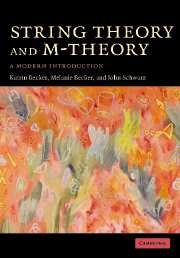
This textbook is globally recognized as a definitive and comprehensive resource for understanding String Theory and M-Theory, directly addressing 'Fundamental Extended Objects and Higher-Dimensional Unification.' Its rigorous mathematical treatment and clear exposition make it ideal for a 57-year-old with a strong intellectual curiosity and background, enabling deep intellectual engagement (Principle 1). It provides the foundational knowledge and advanced conceptual tools necessary to bridge abstract ideas to a robust theoretical understanding (Principle 2). Its academic depth ensures sustained developmental leverage for advanced study (Principle 3).
Also Includes:
- Casio fx-991EX ClassWiz Scientific Calculator (35.00 EUR)
- Bi-Office Maya Magnetic Dry Erase Whiteboard (120x90cm) (100.00 EUR)
- Staedtler Lumocolor Whiteboard Markers (Assorted Colors, 4-pack) (12.00 EUR) (Consumable) (Lifespan: 12 wks)
- Physics World Digital Subscription (1 Year) (150.00 EUR) (Consumable) (Lifespan: 52 wks)
DIY / No-Tool Project (Tier 0)
A "No-Tool" project for this week is currently being designed.
Complete Ranked List3 options evaluated
Selected — Tier 1 (Club Pick)
This textbook is globally recognized as a definitive and comprehensive resource for understanding String Theory and M-T…
DIY / No-Cost Options
A highly acclaimed popular science book that introduces string theory, M-theory, and higher dimensions to a general audience with vivid analogies and accessible explanations.
While an excellent introductory work for conceptual understanding and sparking initial interest, 'The Elegant Universe' lacks the mathematical depth and rigorous theoretical framework provided by a graduate-level textbook. For a 57-year-old seeking deep developmental leverage in this specific advanced topic, a more academic and mathematically intensive resource is preferred to foster genuine mastery rather than just broad comprehension.
An online course specialization typically consisting of several modules, featuring video lectures, quizzes, and assignments on string theory and related concepts.
Online specializations offer structured learning and can be very engaging. However, for a 57-year-old prioritizing self-paced, deep, and potentially lifelong reference for a highly complex topic, a comprehensive textbook often offers greater depth, permanence, and the ability to re-engage with specific derivations at will. The 'lifespan' of access to online courses can also be a limiting factor compared to owning a physical text. While valuable, it may not provide the ultimate, enduring developmental leverage of a top-tier academic textbook.
What's Next? (Child Topics)
"Fundamental Extended Objects and Higher-Dimensional Unification" evolves into:
Compactified Extra Dimensions and Microscopic Unification
Explore Topic →Week 7074Large or Warped Extra Dimensions and Macroscopic Gravity
Explore Topic →** "Compactified Extra Dimensions and Microscopic Unification" refers to theoretical frameworks, prominently including various string theories, where higher spatial dimensions are posited to be very small and curled up (compactified), making them observable only at microscopic scales. In these models, the compactified dimensions provide the necessary geometric structure for the consistent unification of fundamental forces (including gravity) and the generation of observed particle spectra, arising from the dynamics of fundamental extended objects like strings or branes at very high energies. "Large or Warped Extra Dimensions and Macroscopic Gravity" encompasses models where extra spatial dimensions are either macroscopically large or possess a non-trivial, warped geometry (e.g., Randall-Sundrum models), allowing them to significantly influence gravitational interactions at scales larger than the Planck length. These theories often propose that our observable universe is a higher-dimensional membrane (a 'brane') embedded within this larger extra-dimensional spacetime, primarily aiming to address specific challenges such as the hierarchy problem or to provide alternative explanations for cosmological phenomena by modifying gravity at lower energies, rather than solely focusing on a complete force unification at the highest energy scales. These two categories represent distinct conceptual and phenomenological approaches to how higher dimensions and extended objects manifest and contribute to physics within the broader paradigm of higher-dimensional unification.