Understanding and Interpreting the Non-Human World
Level 3
~2 months old
Feb 23 - Mar 1, 2026
✅ Tool Selected
Primary tool identified based on developmental leverage. Awaiting acquisition.
Strategic Rationale
This week's objective is to teach a 10-week-old the difference between the 'animate' (human) and 'inanimate' (non-human) world. Based on a meta-analysis of developmental research (w10-final gemini.pdf), this is achieved by teaching 'physical contingency': the 1:1, predictable feedback an object provides, which is distinct from the variable, social feedback a caregiver provides.
The optimal tool is not a single product but a two-part 'Animacy Distinction System' that isolates this lesson. It pairs a best-in-class passive visual stimulus (Etta Loves Muslin) to invite interaction with a best-in-class active feedback tool (Nienhuis Bell) to consequence that interaction. This system is precisely engineered to bridge the infant from Piaget's Substage 2 (body-focused) to Substage 3 (object-focused) by enticing their new 'batting' motor skill (P4) and rewarding it with immediate, synchronized, non-social feedback (P3, P5).
Implementation Protocol (7-Day Window):
- Objective: Create a clear 'A/B test' for the infant, contrasting the passive visual world (Muslin) with the contingent, active non-human world (Bell) to teach physical contingency.
- Days 1-2: Visual Field Establishment (Principle 1):
- Action: Unfold the Etta Loves 'Fern' or 'Dandelion' muslin. During an alert window, lay it flat for tummy time or drape it 8-12 inches (20-30 cm) from the infant's face as they lie on their back.
- Goal: Allow 5-10 minute sessions of passive observation to stimulate the visual cortex (per Sussex Baby Lab research).
- Days 3-4: Introducing Physical Contingency (Principles 2, 4, 5):
- Action: Place the infant on their back. Hold the Nienhuis Bell in their 8-12 inch focal range and shake it gently to help them practice auditory localization.
- Action: Gently place the 4.5cm bell cube where their uncoordinated 'bat' (P4) can make contact.
- Goal: The instant their hand moves and the bell jingles, the infant receives the 1:1, perfectly synchronized feedback loop (P5). This is the 'cognitive bridge' (P2) from a body-focused action to an object-focused consequence.
- Days 5-7: The 'Animacy Test' & Integration:
- Action: Position the infant for tummy time on the Etta Loves muslin. Place the Nienhuis Bell on a high-contrast pattern, just at the edge of their 'batting' range. The muslin (P1) motivates the head-lift, and the bell (P3/P5) provides the salient target.
- Explicit 'A/B Test' (P3): Engage the infant with the bell. When they bat, it makes a sound. Be present but vocally quiet. Then, put the bell down and engage the infant socially (talking, cooing). This explicitly contrasts the 100% predictable, physical reaction of the 'non-human' tool with the variable, social reaction of the 'human' caregiver.
Primary Tools Tier 1 Selection
Etta Loves Plant Print Muslins
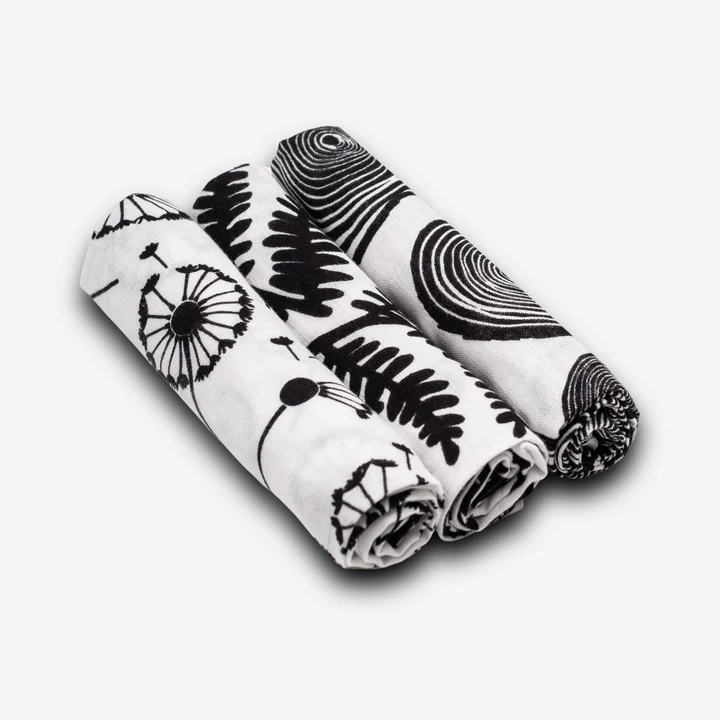
This item is the 'visual invitation' component of the Tier 1 System. It is selected over all other high-contrast textiles due to its 'professional-grade' efficacy, based on an explicit research partnership with the University of Sussex Baby Lab (w10-final gemini.pdf). The patterns ('Fern', 'Dandelion') are not arbitrary; they are scientifically-designed visual stimuli, precisely scaled to match a 10-week-old's visual capabilities (Principle 1).
Brand Justification: Etta Loves patterns are developed in consultation with orthoptists and validated by the Sussex Baby Lab to support infant visual development. The 100% GOTS Certified Organic Cotton ensures the highest material safety (non-toxic, suitable for mouthing). Specifications: Set of 3 muslin squares. Dimensions: 80cm x 80cm. Material: 100% GOTS Certified Organic Cotton. Patterns: 'Fern', 'Dandelion', 'Tree Ring' (scientifically-scaled black-and-white for 0-4m vision). Sourcing Viability: Standard Retail. Readily available from eu.ettaloves.com.
Pros: Unmatched scientific backing for visual stimulation efficacy; highest-quality, non-toxic material (GOTS cotton); large, versatile visual field for tummy time or as a drape. Cons: As a standalone item, it is entirely passive and requires the Nienhuis Bell to complete the sensory-motor feedback loop.
Grasping Cube with Bell
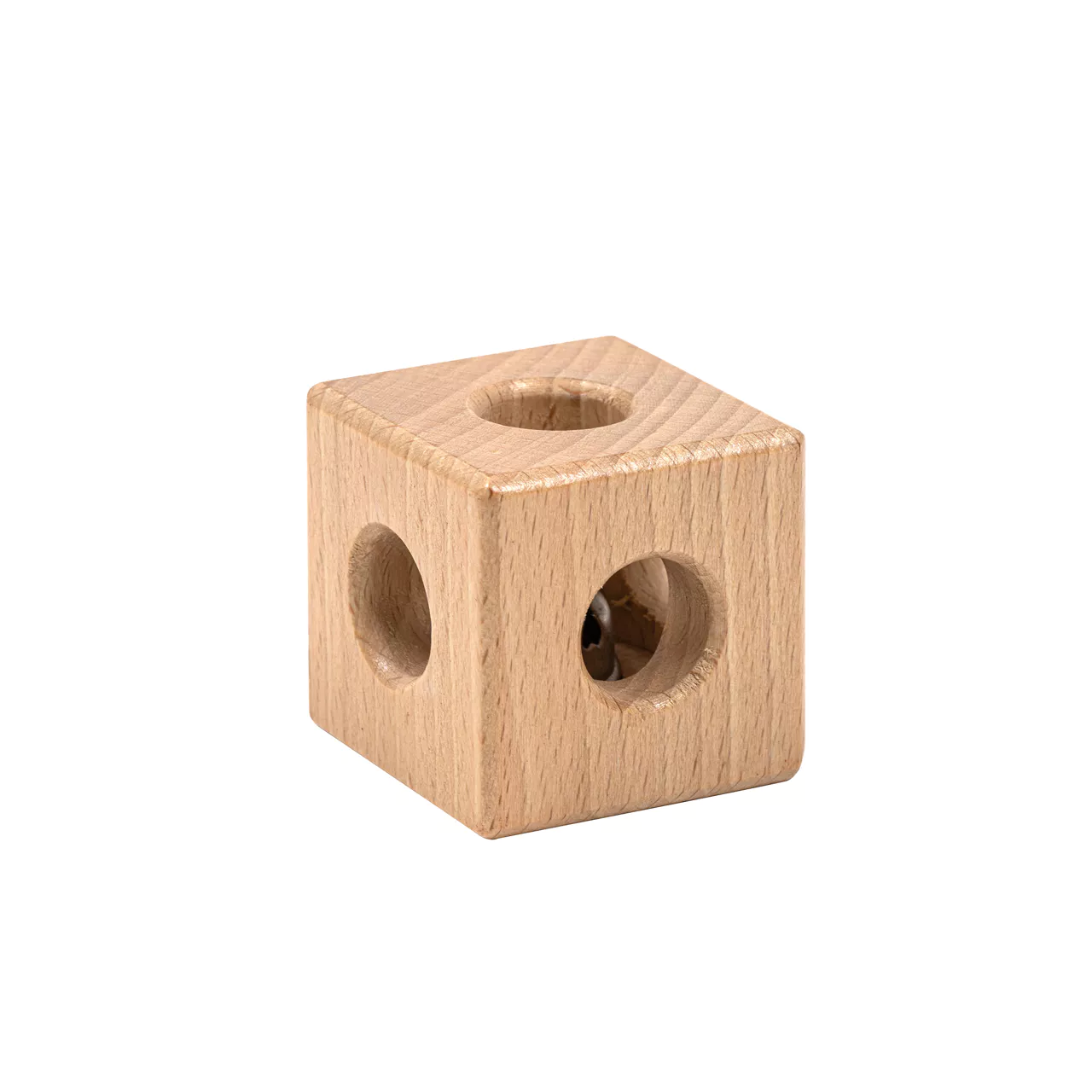
This item is the 'contingent consequence' component of the Tier 1 System. It is a professional-grade pedagogical instrument, not a toy, designed to perfectly isolate the 'consequence' of an action. When 'batted' (Principle 4) by a 10-week-old's uncoordinated hand, it provides a crisp, immediate, non-social sound. This is the essence of 'interpreting the non-human world' (Principle 3) and provides the perfect 1:1 feedback loop (P5) to bridge the infant to Piaget's Secondary Circular Reactions (Principle 2) (Research: w10-final gemini.pdf).
Brand Justification: Nienhuis is the original, AMI (Association Montessori Internationale) certified manufacturer of Montessori materials. Its 4.5cm cube shape is precisely engineered to be 'battable' and grasped by an emerging, clumsy hand. Specifications: SKU: 047700. Dimensions: 4.5cm x 4.5cm x 4.5cm. Material: 100% European Beech wood, internal metal bell. Sourcing Viability: Specialty-Professional. This is pedagogical equipment that must be acquired via official AMI-certified Montessori distributors (e.g., Nienhuis.com, Gonzagarredi, Heutink). This complexity is justified by its pedagogical purity and superiority to all commercial alternatives.
Pros: Pinnacle of pedagogical design (AMI-certified); perfectly isolates the 1:1 contingent feedback loop; extremely durable (solid beech wood, 500+ week estimated lifespan). Cons: Complex 'Specialty-Professional' sourcing; requires a specific sanitization protocol (no water submersion); lacks visual stimulation (which is provided by its partner item, the Etta Loves Muslin).
DIY / No-Tool Project (Tier 0)
A "No-Tool" project for this week is currently being designed.
Complete Ranked List8 options evaluated
Selected — Tier 1 (Club Pick)
This item is the 'visual invitation' component of the Tier 1 System. It is selected over all other high-contrast textil…
This item is the 'contingent consequence' component of the Tier 1 System. It is a professional-grade pedagogical instru…
DIY / No-Cost Options
A comprehensive, multi-tool kit specifically designed for the 0-12 week window, including high-contrast cards, mittens, a rattle, and other sensory items.
This is the definitive all-in-one commercial kit for Week 10, superior to the 0-12 month gym due to its 'Hyper-Focus' on the 0-12 week window (Research: w10-final gemini.pdf). It addresses all 5 First Principles (visual, cognitive, contingency, motor, sensory) in a single, convenient, standard-retail package. It is ranked as a candidate only because the Tier 1 'Animacy Distinction System' offers a purer, more isolated lesson in physical contingency. **Pros:** Precisely targeted to the 0-12 week window; comprehensive and research-backed (GOTS, FSC materials); simple 'Standard Retail' acquisition. **Cons:** Higher total cost; less 'hyper-focused' than the pure two-tool system; feedback is one of many features, not the isolated focus.
A high-quality, long-term (0-12+ month) activity gym with a wooden frame, GOTS-certified cotton components, and 5 detachable sensory toys.
A best-in-class, long-term play gym (Research: w10-final gemini.pdf). It is demoted from the primary selection because it fails the 'Hyper-Focus Principle' for a 7-day window; its developmental leverage is diffused over 12+ months, making it less potent for Week 10 than the 0-12 *week* 'Looker Kit'. It remains a high-quality, sustainable alternative. **Pros:** Excellent 'grows-with-me' value; high-quality, durable materials (Beech wood, GOTS cotton); strong B&W components; simple 'Standard Retail' acquisition. **Cons:** Fails 'Hyper-Focus Principle'; less potent for the specific 7-day window; high cost and large footprint.
A single-object toy with a web-like structure of sustainable rubberwood and elastic cords, with sliding beads.
The best single-object tool that integrates all principles (Research: w10-final gemini.pdf). Its open structure is perfectly designed for a 10-week-old's 'batting' and 'catching' (P4), providing synchronized audio-visual feedback (P5). It is a candidate because its auditory feedback (sliding beads) is less 'crisp' and contingent than the Nienhuis bell. **This is a Most Sustainable High-Leverage Alternative.** **Pros:** Best-in-class single-object design; exceptionally easy to grasp/bat; sustainable materials (EN 71); low cost. **Cons:** Auditory feedback is less immediate than the primary choice; primary colors are less visually optimized for Week 10 than B&W.
A 3-pack of 13cm GOTS organic cotton squares with scientifically-designed B&W patterns and integrated feedback (bell, crinkle, mirror).
Applies the same validated Sussex Baby Lab science as the Tier 1 Muslin (P1) but in an active, 'battable' format (P4) that directly addresses sensory integration (P5) (Research: w10-final gemini.pdf). **Pros:** Validated visual science; actively targets 'batting'; GOTS-certified. **Cons:** Sourcing from the UK may have EU shipping delays; feedback is less 'pure' than the Nienhuis bell.
The correct first Montessori visual mobile, featuring black-and-white geometric shapes and a transparent sphere to provide passive visual stimulation.
This is the developmentally correct Montessori mobile for Week 10, replacing the premature 'Gobbi' mobile (Research: w10-final gemini.pdf). It is a pure, passive tool that perfectly addresses Principle 1 (Visual Salience) by providing high-contrast B&W stimulation. It is a candidate because it is entirely passive and does not include the active, contingent feedback loop (P3, P4, P5) required to fully address the node. **Pros:** Pedagogically correct for Week 10 visual development; purely addresses high-contrast focus. **Cons:** Entirely passive; does not provide a motor or auditory feedback loop.
A soft, GOTS-certified organic cotton play mat featuring bold, black-and-white patterns and crinkle sounds.
A high-quality passive visual tool that perfectly addresses Principle 1 (Visual Salience) (Research: w10-final gemini.pdf). It is correctly placed as a mid-range candidate because it is an incomplete tool; as a flat mat, it lacks an active, 'battable' feedback loop (Principles 3, 4, 5). **Pros:** Excellent high-contrast visual field; GOTS-certified organic cotton. **Cons:** Passive tool; lacks elements for 'batting' or contingent auditory feedback.
What's Next? (Child Topics)
"Understanding and Interpreting the Non-Human World" evolves into:
Understanding Objective Realities
Explore Topic →Week 26Interpreting Subjective Significance
Explore Topic →Humans understand and interpret the non-human world either by objectively observing and analyzing its inherent structures, laws, and phenomena to gain factual knowledge, or by subjectively engaging with it to derive aesthetic value, emotional resonance, or existential meaning. These two modes represent distinct intentions and methodologies, yet together comprehensively cover all ways of understanding and interpreting the non-human world.