Knowledge
Creation
Every person is born curious. A baby who keeps stacking and knocking things over — is doing physics. A child who takes a toy apart to see how it works — is engineering. But today's toy stores are full of simulacra — toy kitchens, toy phones, toy tools that simulate reality without real consequences.
Simulacra don't educate — they extinguish curiosity, because reality never truly responds. A child who grows up only with toys learns not to create — but to consume.
The alternative: real tools that interact with real reality. Where balance depends on physics, not a button. Where feedback comes from reality itself — not an adult's score or rating.
"Specific knowledge is found by pursuing genuine curiosity and passion rather than whatever is hot right now." — Naval Ravikant
We look for The Spark — the moment when engagement becomes self-sustaining. They return to the tool without prompting. Ask questions no one taught them. Try things no one suggested. This is the most valuable information — which domain this person's mind responds to from within.
How it works:
1. 5200-week curriculum — a dichotomous tree from birth to 100+ years.
2. Multi-model AI pipeline — each domain analyzed by multiple AI models independently, applying 4 selection tests.
3. The tool itself — we purchase and deliver. Your role is to observe. Reality will report.
Starting in Vilnius. First target — five-year-olds.
Vilnius. 2026. First club. 52 spots per year.
Reserve your spot →Vilnius Club
Every week you receive a physical tool and research material in your hands.
ONLY 52 SPOTS PER YEAR
The Spark
A real tool creates a problem-space where the mind finds something to explore. When this happens — no external motivation is needed.
What we observe (not evaluate)
What we observe (not evaluate)
"With kids, you just need to feed their curiosity. All the really smart kids I know are essentially autodidacts. You can't force a kid to become a self-learner — you can only feed their curiosity."
— Naval Ravikant
How Tools Are Selected
Every tool passes 4 tests. Those that fail are rejected — regardless of popularity or price.
Open-Ended Play Test
Does this tool enable genuine, self-directed play with real materials? Real physical feedback — not simulation. Rejected: single "correct" outcome, closed systems, toy versions.
First-Week Engagement Test
Will the tool captivate within the first 7 days? Low entry barrier + high ceiling. Simple to start but with endless variation.
Divergent Exploration Test
Will different people do different things with the same tool? Does the tool reward the person's own ideas — or just following instructions?
Knowledge Leverage Test
How much accumulated human knowledge does this tool embody? What is its ceiling? Are the principles learned with this tool transferable to higher-leverage domains?
Between two equally good tools, we choose the one that embodies greater knowledge — the maximum leverage a person can authentically explore at their developmental moment.
Reality Reports
| Adult Scoring (not our way) | Reality Feedback (our way) |
|---|---|
| Observer evaluates performance | Person's own engagement tells the story |
| Measures what they "should" be interested in | Reveals what they are actually interested in |
| "They're good at this" (adult projection) | "They can't put it down" (self-evident) |
| Grades, rankings, comparison with others | Self-directed exploration, questions, created things |
The
Dichotomy Tree
Systematic exploration of human potential through progressive specialization.
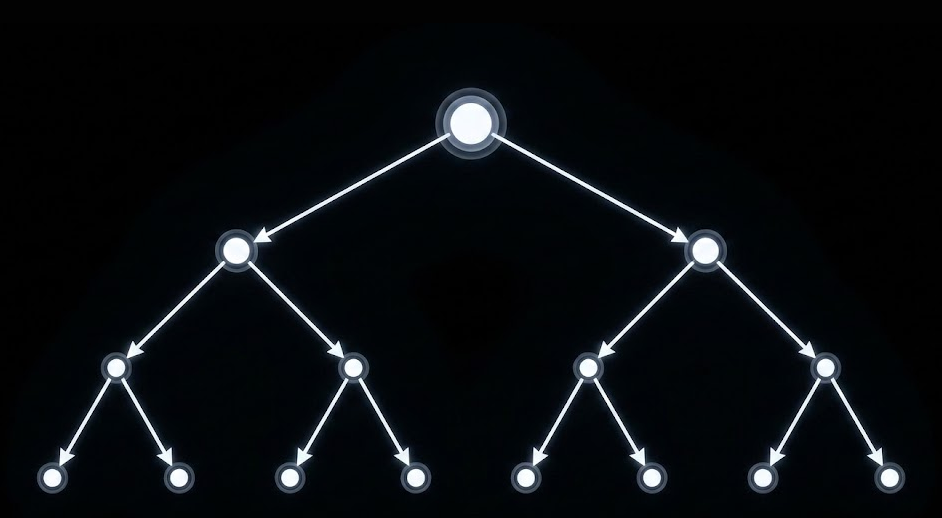
Binary decision tree: each week presents a fundamental choice that shapes the learning path
A dichotomy is a logical split into two mutually exclusive yet collectively exhaustive parts (e.g., Internal vs. External). Any "blended" state between these parts is addressed at the parent level; as long as the element remains unsplit, it represents the whole. Once it branches into a binary pair, the distinction is crystallized. Comparing the parent node to its children builds a complete understanding of the "diff," ensuring a systematic exploration with no gaps left behind.
Progressive Specialization
Each level of dichotomy becomes twice as deep and specialized. Newborns start at the root – the broadest point. This level takes one week, the second level – two weeks, the third – four weeks. The duration doubles with each level, and specialization deepens exponentially.
| Level | Duration/Node |
|---|---|
| 0 | 1 week |
| 1 | 2 weeks |
| 2 | 4 weeks |
| 3 | 8 weeks |
| 4 | 16 weeks |
| 5 | 32 weeks |
| 6 | 64 weeks |
| 7 | 128 weeks |
| 8 | 256 weeks |
| 9 | 512 weeks |
| 10 | 1024 weeks |
| 11 | 2048 weeks |
| 12 | 4096 weeks |
Concrete Example: Week #261 (≈5 years)
8th level topic (one of 256): "Alpha-adrenergic receptor transmission in noradrenergic sympathetic transmission"
Precise path:
Human Potential (Level 0, Week 0) → Internal World (L1, W1) → Somatic Sphere (L2, W5) → Autonomic Processes (L3, W13) → Auton. Nervous (L4, W21) → Sympathetic (L5, W37) → Direct Neurotransm. (L6, W69) → Noradrenergic (L7, W133) → Alpha Receptors (S261)
This point is reached after 261 weeks (≈5 years) of systematic exploration. It is a level where somatic processes narrow down to specific nervous system mechanisms – how norepinephrine acts through alpha-receptors, activating sympathetic nervous system responses (e.g., focus, stress management).
Practically for a five-year-old, this means: understanding how the body responds to challenges, stress, and new learning moments. Tools for this level are oriented towards "bio-feedback" and active self-regulation.
→ See full description for week #261
→ What does a member of week 261 see?
Exponential Depth: Each new level takes twice as long because it doubles the number of topics. By a five-year-old's path (week 261), the 8th level of specialization has already been reached with 256 possible trajectories. In a hundred-year-old's path, the system can continue up to 12+ levels with thousands of detailed topics. The system helps navigate this complex space with with specifically selected tools for each level.
Noradrenergic sympathetic transmission
Check Availability
Enter birth date to find out which developmental stage you are in now and which tools are recommended for you.
Select birth date...
FAQ
Is this truly unbiased?
Why this price (129 €/mo)?
Access to the peak. We don't look at the price; we look at the leverage. Whether it's a humanoid robot, a medical sensor, or a curved board for rocking – if it's the best tool for that week, we aim to acquire it. Community membership allows bringing equipment worth 2000 € to a family for a fraction of the price.
You aren't buying toys; you are funding a shared R&D lab for your child.
Will membership price change?
Physical Club: The price is directly linked to hardware + Digital membership price. Our goal is to keep the monthly fee at approximately 1/10th of the average shelf value. As we expand into older age groups with more complex equipment, the fee may change accordingly.
Digital Membership: The price is linked to research and infrastructure. It is more stable but reflects the costs of maintaining our R&D lab, AI agents, and platform.
Important regarding "Priority Membership" credits: The duration of your free membership is recalculated at the moment of activation based on the price valid at that time. If the price changes before you start, the duration of the credit is adjusted proportionally.
You can monitor current average shelf value on our Expansion Plan page.
Is one week too short?
What about languages?
Why English now? We are a new, evolving initiative. Priorities: (1) Create the core tool library, (2) Create a neat member system, (3) Ensure the stability of club operations. A full multilingual system requires significantly more infrastructure.
The Future: Once we have a stable foundation, we will actively take on expanding multilingual support. We constantly collect feedback and adapt. Your patience helps create a system that serves many languages well, instead of serving one poorly.
Practical advice: If English is not your strength, modern translation tools (Google Translate on your phone, Chrome translators, etc.) can help. However, the best experience (for now) will be for those who can freely read English research material.
How many people do you accept?
Can I keep the tool longer than a week? My child loves it...
What if parts go missing or it breaks?
How do you know the tool "worked"?
How exactly are tools selected?
1. Pre-fill (Step 1) — A quick AI pass populates the shelf with baseline content for a new node. Used once per node via automated API.
2. Research (Step 2) — A deep research prompt is sent independently to 5–7 AI models (Claude, Gemini, ChatGPT, Grok, etc.), each unaware of the others. Each model applies a phased methodology: first understands the domain, identifies failure modes, generates 15–30 candidates, then applies 4 selection tests in sequence. Each model's output is saved as a PDF for transparency.
3. Export existing data (Step 3) — The current database state for this node is exported as JSON. This becomes input for synthesis alongside the research PDFs.
4. Audit / Consolidation (Step 4) — One or two top models synthesize all research PDFs + existing JSON into a single definitive ranked list. The synthesis applies: Enrichment Principle (catalysts above enhancers), Q3 Domain-Alignment Test (misaligned tools capped), 4 selection tests, a binary point-deduction scoring schedule, and Score Gap Enforcement. Conflicts between models are resolved by tracing each argument back to first principles — no majority voting.
5. JSON Extraction / Location Synthesis (Step 5) — The final prose report is converted into importable JSON, with scores adjusted for deliverability to the specific location (e.g., Vilnius, EU delivery).
6. Import (Step 6) — The location-adjusted JSON is imported into the database. The tool is acquired and enters rotation.
Let's stay in touch
Get updates.