Mores Prohibiting Direct Infliction of Bodily Harm
Level 11
~41 years, 6 mo old
Nov 26 - Dec 2, 1984
🚧 Content Planning
Initial research phase. Tools and protocols are being defined.
Strategic Rationale
For a 41-year-old, the fundamental 'mores prohibiting direct infliction of bodily harm' are already deeply internalized. Developmental leverage at this stage shifts from basic compliance to the sophisticated application and upholding of these mores within complex adult relationships, professional environments, and community contexts. This includes preventing harm (physical, psychological, reputational) through effective communication, ethical decision-making, and conflict de-escalation.
'Difficult Conversations: How to Discuss What Matters Most' by Douglas Stone, Bruce Patton, and Sheila Heen is the world's best developmental tool for this specific age and topic. It addresses the core mechanisms by which individuals navigate high-stakes interactions, misunderstandings, and disagreements – situations where the risk of inflicting harm (often emotional, verbal, or reputational, which can escalate) is significant. The book provides a practical, research-backed framework for:
- Nuanced Ethical Navigation & Conflict De-escalation: It teaches how to identify and unpack the three layers of a difficult conversation ('What Happened,' 'Feelings,' and 'Identity' conversations), enabling individuals to approach conflicts constructively rather than reactively. This directly prevents escalation that could lead to various forms of harm.
- Impact Awareness & Empathy Integration: By guiding readers to distinguish between intent and impact, understand differing perspectives, and explore their own contributions to a problem, the book cultivates a deeper sense of empathy and awareness of how one's actions and words are perceived and felt by others. This is crucial for proactively preventing harm.
- Upholding Mores in Practice: The skills taught (e.g., listening to understand, expressing feelings without judgment, reframing accusations as contributions, learning to 'message') provide the practical 'how-to' for upholding the underlying respect for others' well-being that these mores demand, even in challenging circumstances.
Implementation Protocol for a 41-year-old:
- Initial Read-Through & Self-Assessment: Read the entire book, highlighting key concepts and conducting the self-assessment exercises provided. Reflect on past difficult conversations and identify patterns of ineffective communication or instances where harm was unintentionally (or intentionally) inflicted or avoided.
- Targeted Application: Select 1-2 current or anticipated 'difficult conversations' (e.g., with a colleague, family member, friend, or within a community group) and apply the specific frameworks (e.g., identifying the three conversations, shifting from blame to contribution, preparing a 'learning conversation' opening) to prepare for and engage in these interactions.
- Reflection & Journaling: Maintain a reflective journal. After each application of the book's principles, document the experience: what went well, what was challenging, what was learned about self and others, and how the outcome differed from previous approaches. Analyze how the process helped uphold or potentially violate the 'mores prohibiting direct infliction of bodily harm.'
- Peer Discussion (Optional but Recommended): Discuss insights and challenges with a trusted peer, mentor, or professional coach. This provides external perspective and reinforces learning.
- Ongoing Practice & Integration: Recognize that mastering these skills is an ongoing process. Continuously integrate the frameworks into daily interactions, transforming the approach to conflict and communication into a foundational aspect of personal and professional conduct.
Primary Tool Tier 1 Selection
Book Cover: Difficult Conversations
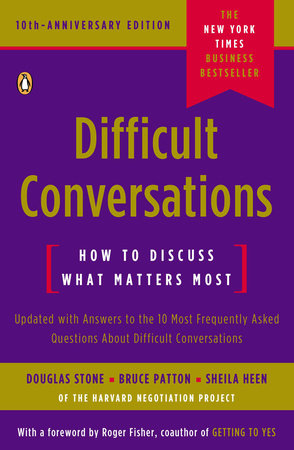
This book is unparalleled in providing a structured, empathetic, and effective framework for navigating high-stakes personal and professional interactions. For a 41-year-old, it is a crucial tool for upholding the mores against direct harm by teaching preventative strategies in communication. It focuses on understanding different perspectives, managing emotional responses, distinguishing intent from impact, and finding constructive ways forward without resorting to actions or words that cause harm. It directly supports nuanced ethical navigation, impact awareness, and ultimately, fosters environments where direct harm is less likely through improved relational dynamics.
Also Includes:
- Journal for Reflective Practice (e.g., Leuchtturm1917 A5 dotted notebook) (19.95 EUR) (Consumable) (Lifespan: 52 wks)
DIY / No-Tool Project (Tier 0)
A "No-Tool" project for this week is currently being designed.
Complete Ranked List3 options evaluated
Selected — Tier 1 (Club Pick)
This book is unparalleled in providing a structured, empathetic, and effective framework for navigating high-stakes per…
DIY / No-Cost Options
A popular and highly effective guide to handling high-stakes dialogues to achieve desired outcomes.
While 'Crucial Conversations' is an excellent resource for managing high-stakes discussions and preventing relational breakdowns, 'Difficult Conversations' provides a slightly deeper dive into the underlying psychological and emotional aspects of conflict (intent vs. impact, feelings, identity). This makes 'Difficult Conversations' marginally more aligned with the nuanced understanding and upholding of 'mores prohibiting direct infliction of bodily harm' by addressing the root causes of misunderstandings and potential harm more comprehensively.
A framework for empathetic communication developed by Marshall B. Rosenberg, focusing on expressing observations, feelings, needs, and requests.
Nonviolent Communication (NVC) offers a powerful and transformative approach to communication that inherently aims to prevent harm and foster connection. However, it presents a more specific, prescriptive methodology. 'Difficult Conversations' offers a broader analytical framework for dissecting any challenging interaction, making it a more foundational tool for understanding and navigating the diverse ways 'mores' can be tested in adult life, before delving into specific communication styles.
What's Next? (Child Topics)
"Mores Prohibiting Direct Infliction of Bodily Harm" evolves into:
Mores Prohibiting Direct Infliction of Bodily Harm on Others
Explore Topic →Week 6252Mores Prohibiting Direct Infliction of Bodily Harm on Self
Explore Topic →All mores prohibiting the direct infliction of bodily harm can be fundamentally and exhaustively categorized by the primary recipient of that harm: either it is inflicted upon another individual or group, or it is inflicted upon oneself. This dichotomy provides a mutually exclusive division, as an act of direct bodily harm is directed at one or the other, and comprehensively covers all possible instances within the parent concept, reflecting a fundamental distinction in moral and social thought regarding the target of a prohibited harmful act.